




The WWF Endorses the Killing of Wild Animals, Too
The World Wildlife Fund (WWF) gives special meaning to the word “conservation.”
The organization, founded in 1961 by a group of wealthy trophy hunters,
apparently believes that conserving animals means keeping them around
long enough for well-heeled “sportsmen” to blast them
out of the woods, oceans, skies, plains of Africa, and jungles of
Asia. Past WWF chapter presidents include C.R. “Pink”
Gutermuth, who also served as president of the National Rifle Association,
and trophy hunter Francis L. Kellogg, who is legendary for his massive
kills. In its early days, the WWF even used fur auctions to raise
funds.
Since then, the WWF has learned that most people are appalled by hunting
and trapping, so today, the organization veils its true stance under
phrases like “sustainable development,” arguing that killing
is acceptable under some circumstances. When answering difficult questions
about its policy on hunting, trapping, and whaling, the WWF is careful
never to state outright that it approves of all these activities.
But don’t be fooled, the WWF’s intentions are all too
clear and deadly.
Sealing
According to the Web site of the WWF’s Canadian office, “WWF
is not an animal welfare organization. We support the hunting and
consumption of wild animals provided the harvesting does not threaten
the long-term survival of wildlife populations. WWF has never opposed
a sustainable seal hunt in northern or eastern Canada.” However,
despite the WWF’s portrayal of the situation, the Canadian seal
hunt is anything but a “subsistence” hunt––it
is the largest slaughter of marine mammals in the world. Quotas established
by the Canadian government have soared to an all-time high: 350,000
seals per year for the next three years. Not since the mid-1800s,
when unrestricted slaughter saw a million seals per year killed, has
so much blood been shed on the ice off Canada’s East Coast.
Worse is that the Canadian government has stated in internal documents
that having the WWF’s support for any raise in seal quotas is
important, and the WWF’s position statement suggests that it
had been working with the Canadian government before the quota was
announced. In other words, the WWF had the power to help avert the
largest quota of harp seal pups in history but chose, instead, to
let it happen without so much as a word of opposition.
Whaling
While the WWF states that it opposes “commercial whaling,”
it does support the slaughter of whales by native tribes and under
some other conditions. When asked directly about its policy, WWF is
vague, stating: “WWF’s views on whether sustainable whaling
should be permitted derive from its mission ‘to conserve nature
and ecological processes and to help build a future in which humans
live in harmony with nature.’” In the past, WWF officials
have clearly stated that “WWF International has the national
WWF organizations behind it in the view that as soon as one can ensure
a sustainable commercial harvest of the great whales under secure
international control, then whaling will no longer be a WWF concern.”
Sport Hunting
As one would expect of an organization founded by hunters, the WWF
does not oppose the slaughter of animals with guns and other weapons
for sport. Rather than working to stop the killing, the WWF believes
that hunting should be regulated, arguing that wealthy trophy hunters
can bring income to poorer nations. The WWF claims that it has no
power to stop hunting, stating, “The decision to allow trophy
hunting is a sovereign one made entirely by the governments concerned.
… We will continue to monitor governments’ enforcement
of important trade laws to ensure that trophy hunting is done within
the legal standards of that area.”
Elephants
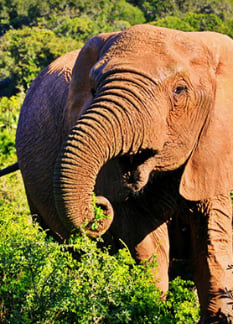
The WWF believes that culling—another way of saying “killing”—elephants
is acceptable, as is the trade in ivory, because the profits that
it brings spur governments to keep elephants from going extinct. In
2000, U.S. News & World Report reported that WWF representatives
traveled to Nairobi to ask the United Nations to lift the ban on the
ivory trade in order to allow a “sustainable harvest of ivory
for horns and hunting trophies.”
The WWF’s bizarre view—that we must kill some animals
now in order to save animals to kill later—has proved false
time and again. The trade in ivory has only encouraged rampant poaching,
the senseless slaughter of elephants. The WWF tries to duck the issue
by falsely stating, “The decision to cull, or to select animals
from the herd for removal or death, is indeed an agonizing choice,
but it is one made entirely by the governments concerned and there
is no international involvement in those decisions.”
Trapping
As with hunting and whaling, the WWF refuses to condemn the massive
killing of animals with steel-jaw leghold traps. While calling itself
a “preservationist” organization that “seek[s] to
be the voice for those creatures who have no voice,” the WWF
stands back from the issue, stating that “the trade in furs,
skins, and other products of animals that are not endangered isn’t
the focus of our campaign.”
But no matter how hard the WWF tries to “greenwash” its
support of animal slaughter, its real message rings out loud and clear:
Animals are ours to hunt, trap, kill, poison, and use as we see fit.
And although appeals to preserve genetic diversity, ecosystems, and
the planet sound good on paper, they mean little if what the WWF is
really advocating is more efficient killing fields.
Wolf Hunting
Despite an ongoing international tourist boycott that was called in
response to the wolf “control” program in Alaska, in which
at least 100 wolves have been shot as of March 2004, the WWF is promoting
several trips to Alaska throughout June, July, and August 2004 as
part of “WWF Travel,” an “ecotourism” program.
When asked why the WWF was sending its members to Alaska, effectively
undermining efforts to save wolves in the state, the WWF travel desk
representative stated that the WWF did not consider the matter of
wolf-killing a priority.